

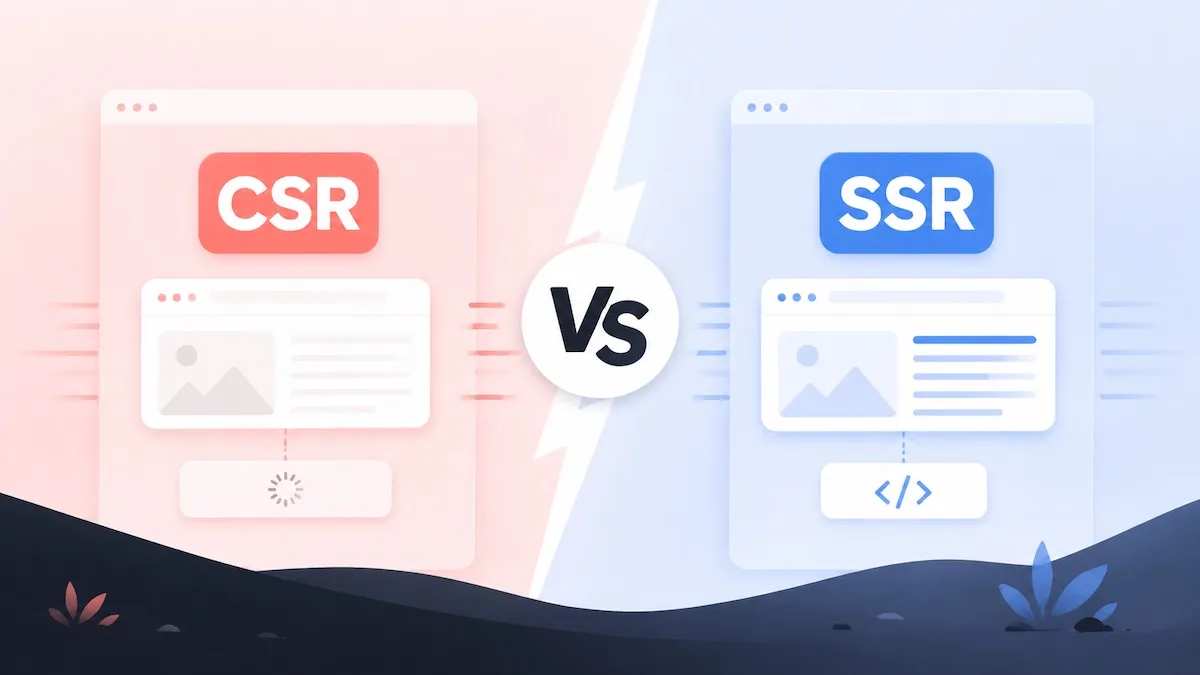
Server-Side Rendering (SSR) Vs. Client-Side Rendering (CSR) - What's Better for SEO?

Modern web applications can render the content in two fundamentally different place: on the server before the response is sent or in the browser, after the response arrives.
The choice between two - Server-Side Rendering (SSR) and Client-Side Rendering (CSR) is not limited to implementation. It affects how humans and web crawlers (Googlebot, LLM agents) experience a web-page.
How CSR Works
Client-side rendering sends the browser a near-empty HTML document. The document references on or more JavaScript bundles. The browser:
Receives minimum HTML shell. It typically contains
<div id="root"></div>and<script>tags.Downloads the JS bundle - often about 100-500 Kb gzipped.
Parses and executes the JS
Fetches data from one ore more APIs
Constructs the DOM dynamically
Renders the content on the browser window
CSR gained popularity along with the rise of React JS, Vue.js (with Vite), Angular, Svelte and Ember.js (without FastBoot). Single-page applications aka SPAs built with these frameworks are typically CSR by default.
Advantages of CSR
Rich Interactivity: One loaded, the app behaves like a native experience. Instant clicks, transitions, live updates. No full-page server reloads.
Reduced server load: The server only sends static assets and serves API requests. Rendering is all handled by user's device.
Simple deployment: Static HTML and JS can be served from a CDN. No Node.js server, no complex rendering pipeline.
Faster deployment cycle: Hot module replacement, component-driven workflows, and a mature toolchain make iteration faster and smoother.
Better real-time UX: Live notifications, inline edits and collaborative features are easier to build.
Disadvantages of CSR
Slow initial paint: First Contentful Paint (FCP) and Largest Contentful Paint (LCP) are delayed because content waits on JS download + execute + data fetch.
Poor SEO (needs workaround): Crawlers receive an empty shell. Google does run JS in a secondary indexing pass, but the pass is slower, queued and inconsistent - mostly for large websites.
Worse AI answer engine compatibility: ChatGPT, Perplexity, Claude and Google AI overviews often skip JS execution. They read the raw HTML response.
Schema markup risk: If JSON-LD is injected by JavaScript, first-pass crawlers miss it.
JS dependency: Users with JS disabled, slow connections or older devices see degraded experience. Often, they'll see a blank page.
Larger client bundles: Initial download is always heavier, hurting performance on mobile and low-bandwidth connections.
As you can see - CSR excels in interactivity. However, it can confuse crawlers. If web crawlers can't see the content in its totality; it will affect the ranking potential of the page.
How SSR Works
Server-side rendering generates the complete HTML code on the server before sending it to the browser. The browser:
Sends a request
Receives fully rendered response - content, schema, metadata - all of it.
Paints the page immediately
Optionally hydrates with JS to enable interactivity afterward.
Common SSR tech stack includes Next.js (React), Nuxt (Vue), SvelteKit (Svelte), Remix (React), Astro, Ember.js + FastBoot, traditional PHP (Laravel, Symphony, WordPress, phpBB, XenForo), Ruby on Rails, Django etc.
Many even support hybrid mode - SSR on initial load and then client-side navigation and interactivity. The first paint is what matters for the crawlers and AEO.
Advantages of SSR
Fast initial paint: The HTML contains the content and crawlers can immediately see it. No JS blocking.
Strong SEO: Crawlers see complete content along with metadata on the first request. No JS execution is required.
AI engine compatibility: AEO crawlers consistently read SSR output. Citation rates are higher.
Schema visible on first paint: JSON-LD embedded in the response is read every time by every crawler.
Better Core Web Vitals: LCP is dramatically easier to pass when content is in initial HTML.
Works with JS: Users on slow networks, older devices or with JS disabled can still see the content.
Better social previews: Open Graph and Twitter card tags are present on first request. Link previews on Slack, LinkedIn and even messaging apps like LinkedIn, iMessage all work reliablty.
Disadvantages of SSR
Higher server load: Every page render hits the server. Aggressive caching is required at scale.
Slower development iteration: Hot reload is harder. Server-rendered components have stricter constraints (no
windowaccess during render, hydration mismatches to debug).More complex deployment: Requires a backend server. Edge deployment is possible; but it adds complexity.
Time to interactive: Even though content paints fast, full interactivity may still wait for JS hydration. Hydration mismatches can cause visible glitches.
SSR Vs CSR - What is better for Community Platforms?
A community platform can compound the value of the user-generated content by letting crawlers and LLMs index the content. Every user-generated discussion, article, question and answer is a potential long-tail search entry point.
Your community can attract organic traffic simply by letting crawlers read your content and index it.
For larger web forum and community software, SSR is a much better choice over CSR. Here's why:
Index Depth Shrinks: Google's secondary JS-rendering pass doesn't reach every page. The deeper the forum, the more posts get skipped or delayed. A community with 10,000 discussions might only have 4000 - 6000 content pieces effectively indexed.
Schema Coverage is Unreliable:
DiscussionForumPosting,QAPage,Article,JobPostingand other schemas are how crawlers quickly recognize the content for AI overviews and answer engines. CSR-injected schema is not very reliable.AEO Citations Evaporate: ChatGPT, Perplexity and other similar answer engines refer to answers from forums. The trend is visible. You may notice these AI tools often refer content from Reddit and forums.
Why Jatra Chose SSR
Jatra bakes advanced SEO and AEO in its core. While forums rely on interactivity, we did not want to lose out on the SEO capabilities of our platform. Getting new users into the community is a bigger challenge for most business forums and SEO solves that problem to a great extent.
Jatra renders the entire page on the server side, makes use of smart caching and uses modern technology like AlpineJS and Livewire to introduce interactive elements. For example, when a user clicks 'Like' button, the full page is not rendered. The front-end only sends the post + user information to the backend.
If you are looking for an SEO optimized forum software, look no further. Jatra could be your best choice.
Refer: Best Forum Software for SEO.