

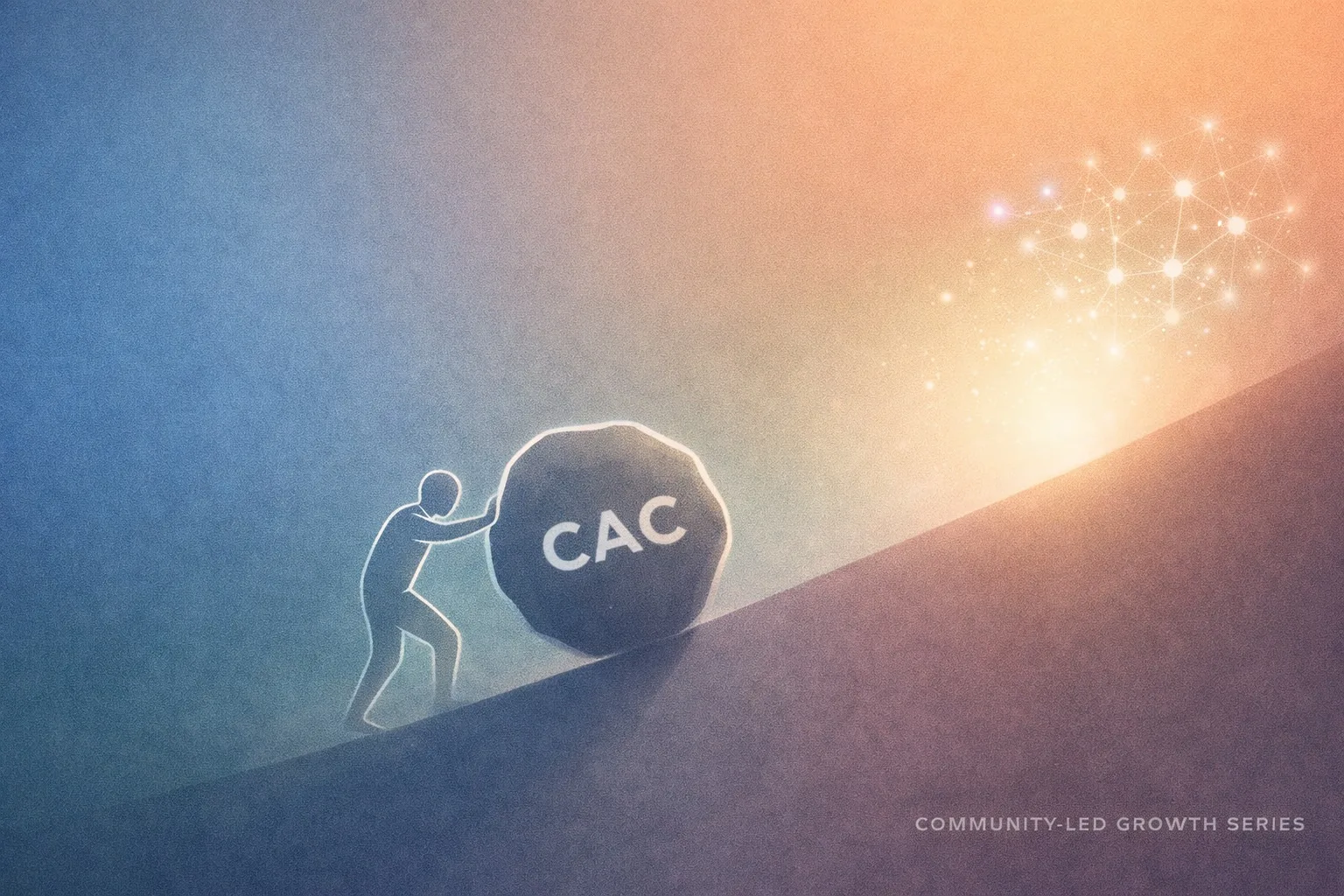
How Community Reduces Customer Acquisition Cost for SaaS

Before founding Jatra, I was Head of Growth at a Singapore and India based B2B SaaS startup.
My biggest headache was reducing customer acquisition cost.
If you're operating between $3M and $15M ARR, you’ve likely felt this pressure too.
Paid channels get crowded. Cost per click rises. Demo volume becomes more expensive to maintain.
At the same time, support tickets increase. Customer success teams expand. Hiring accelerates.
Margin starts compressing from both ends.
If CAC keeps rising, the issue is rarely tactical.
It is structural.
Let’s break it down.
Why Customer Acquisition Cost Keeps Rising in B2B SaaS
Paid acquisition operates as an auction.
The more B2B SaaS companies compete for the same high-intent keywords, the more expensive attention becomes.
You can optimize campaigns. Improve creative. Refine targeting.
But you cannot reduce competition density.
When more SaaS vendors bid on the same solution-aware keywords, cost per click rises. When CPC rises, blended customer acquisition cost rises.
This is not always a marketing performance issue.
It is often market pressure.
“Optimize harder” might improve efficiency for a quarter.
It does not change the structure.
And when the structure does not change, the pressure returns.
Lifetime Value: The Lever Most Teams Underestimate
If CAC is rising, what actually moves the needle?
Not better ads.
Better economics.
The only sustainable way to tolerate rising acquisition cost is to increase lifetime value.
In B2B SaaS, that usually means:
Lower churn
Higher expansion revenue
Faster onboarding
Deeper product adoption
When customers stay longer, effective CAC decreases.
When customers expand usage across teams or features, effective CAC decreases.
This is basic math.
You can keep fighting the numerator.
Or you can strengthen the denominator.
Retention is not a soft metric.
It is a financial lever.
Research from Bain & Company suggests that even modest improvements in customer retention can meaningfully increase profitability in subscription businesses.
In B2B SaaS specifically, improved retention often reduces both churn and the need to continuously increase paid acquisition budgets.
Lifetime value changes the CAC equation.
Which means improving retention reduces acquisition pressure.
So how do you improve retention structurally?
Not with more onboarding emails.
Not with another feature release.
You improve it by changing customer behavior.
And that is where community becomes powerful.
How Community Improves Retention and Lowers Effective CAC
Most churn does not happen because the product is broken.
It happens because usage remains shallow.
In B2B SaaS, shallow usage means:
One team uses one feature
No internal champions emerge
Knowledge stays fragmented
Customer success handles repetitive questions
When customers build workflows, relationships, and habits around your product, leaving becomes harder.
A structured customer community changes how customers experience your product.
They see how other companies solve similar problems.
They discover advanced use cases your onboarding never covered.
They learn integrations, workflows, and shortcuts from peers.
This deepens adoption across teams.
Deeper adoption increases stickiness.
Stickiness increases lifetime value.
Higher lifetime value reduces effective customer acquisition cost.
Community does not magically reduce ad spend.
It improves the economics behind the spend.
That is structural leverage.
Community as an Organic Acquisition Engine
Reducing CAC is not only about retention.
It is also about acquisition mix.
Most B2B SaaS companies rely heavily on paid channels to drive demo requests.
Paid acquisition is predictable.
But predictable does not mean scalable.
When every new demo requires incremental ad spend, growth remains linear.
Community introduces leverage.
Every customer discussion creates long-tail, high-intent content.
Questions about integrations. Enterprise readiness. Migration concerns. Security considerations.
These are real buying signals.
Unlike social media posts, structured community discussions persist.
They rank.
They compound.
They capture intent that paid campaigns often miss.
Research from BrightEdge shows that a large portion of organic search traffic comes from long-tail queries rather than head terms.
Communities naturally capture these queries because customers ask specific operational questions.
“How do we integrate this with Salesforce?”
“Is this secure enough for enterprise?”
“What happens when we scale beyond 1,000 users?”
Each discussion becomes an entry point.
Over time, the community becomes an organic acquisition engine.
Not because marketing produced more blog posts.
But because customers generated real, intent-rich conversations.
This reduces dependency on paid acquisition.
It does not eliminate ads.
It reduces reliance on them.
And when reliance decreases, CAC pressure becomes manageable.
Community Improves Conversion Efficiency
In B2B SaaS, acquisition cost is not just about traffic.
It is about conversion quality.
If 100 visitors become 3 customers, CAC is high.
If 100 visitors become 6 customers, CAC drops significantly.
Community improves conversion by reducing perceived risk.
B2B buying committees evaluate:
Proof of product adoption
Real-world use cases
Responsiveness of the team
Depth of customer engagement
Public community discussions provide that proof.
They show how problems are solved.
They show active customers.
They show that support does not rely solely on ticket queues.
That transparency accelerates trust.
Trust shortens sales cycles.
Improved conversion lowers blended customer acquisition cost.
Again, this is not a marketing tactic.
It is infrastructure design.
Community ROI and the CAC Equation
If you want to evaluate community ROI from a CAC perspective in B2B SaaS, measure what affects the economics:
Retention differences between community-engaged and non-engaged accounts
Expansion revenue from community-active customers
Organic traffic growth from community pages
Conversion rate differences for prospects exposed to community content
Support ticket reduction and cost deflection
If retention improves and organic acquisition expands, blended CAC decreases.
Not because ads got cheaper.
Because dependency weakened.
Rising CAC is not a temporary trend.
It is the natural outcome of competitive B2B SaaS markets.
Companies that rely only on paid acquisition remain exposed.
Companies that build structured community systems create resilience.
Community-led growth does not replace acquisition.
It strengthens the economics behind it.
If CAC pressure is increasing in your SaaS business, it may be time to rethink your growth infrastructure.
We explore the broader framework in our guide to community-led growth for SaaS.