

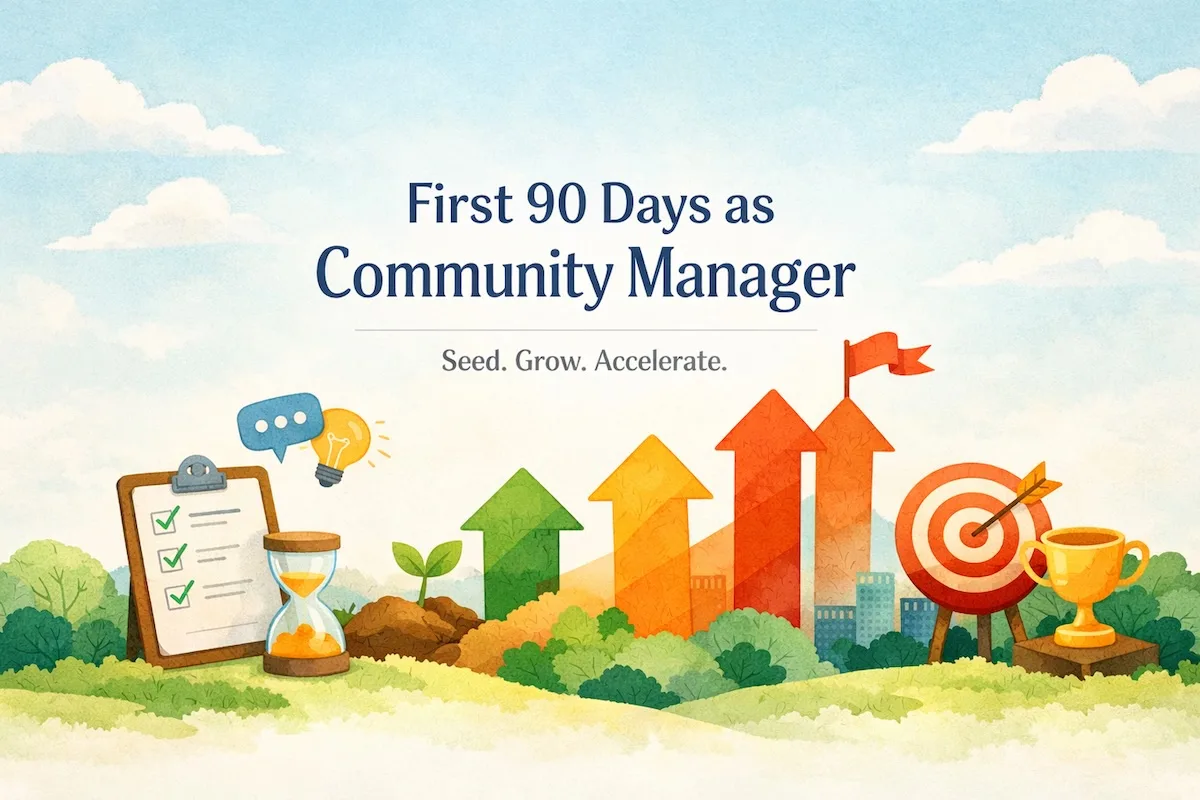
How to Plan Your First 90 Days as a New Community Manager

Congratulations on starting a new role as a community manager. Now that the celebration is over, let’s get to work.
Your first 90 days will be chaotic.
You will be expected to understand the business, build trust with members, support internal teams, spot risks early, and show results before you fully understand what is going on.
That is normal.
The mistake is thinking you can spend the first month “settling in” and magically become useful later. You cannot. A good community manager learns and delivers at the same time.
That is why I like to think of the first 90 days in three phases.
Seed. Grow. Accelerate.
It is simple enough to remember. More importantly, it matches reality.
In the first month, you build the base. In the second, you show progress people can see. In the third, you turn scattered effort into a real system.
Do not confuse activity with progress. A busy community is not always a useful one.
Why this guide matters
A community manager usually walks into three different sets of expectations.
Management wants business outcomes.
Colleagues want support.
Members want value.
All three are fair. All three will compete for your time.
So your job is not just to “increase engagement.” That phrase has ruined enough dashboards already.
Your real job is to figure out what the community is supposed to do, what members actually need, and what deserves your time versus what only looks nice in a monthly report.
Month 1. Seed
Goal: Understand the business, map the community, talk to members, and put a working system in place.
This is not a passive month. You are not here to sip coffee, nod in meetings, and post “Excited to join” on LinkedIn while the community quietly catches fire.
Week 1. Understand the job behind the job
Start with management.
You need clarity on what success looks like in 30, 60, and 90 days.
Ask direct questions:
Why does this community exist?
What does leadership expect it to do?
Is the focus support, retention, product adoption, advocacy, education, or acquisition?
What has already been tried?
What is clearly not working today?
Also review whatever already exists:
past reports
onboarding flows
current channels
moderation rules
email and social presence
previous campaigns
existing content
By the end of Week 1, you should have a rough expectations document. Not something fancy. Just a clear internal note that says, “This is what people think this community is supposed to do.”
That alone will save you from months of confusion.
Week 2. Meet internal teams and audit the community
Now move beyond your direct manager.
Talk to support, product, customer success, sales, and marketing. Each team sees a different side of the customer. You need that full picture.
Ask them:
What questions keep coming up?
What frustrates customers most?
Which users are most engaged?
What do people complain about?
Where can the community reduce friction for your team?
Then spend time inside the community itself.
Audit the basics:
Which channels are active?
Which sections are dead?
Which posts get useful replies?
Which posts get reactions and then disappear into the void?
What questions keep repeating?
What is hard to find?
This is also the right time to review social channels connected to the community. See how social, email, and the community fit together. They should not feel like three cousins meeting for the first time at a wedding.
Week 3. Talk to members and find the signal
Now speak to actual members.
Talk to active members, newer members, lurkers, and the people who signed up but barely show up anymore. Do not build your understanding using only the loudest five people in the room.
Ask simple questions:
Why did you join?
What is useful here?
What feels confusing?
What do you ignore?
What would make you return more often?
What makes you stay silent?
You are looking for patterns, not poetry.
This week is also where you identify the member types that matter:
active members who keep things moving
useful members who give thoughtful answers
silent members who consume but rarely post
noisy members who create motion without much value
That distinction matters. A community full of noise can look active while helping no one.
Week 4. Set KPIs, clean up friction, and build your content calendar
By now, you should know enough to stop guessing.
Set up KPIs early. Not vanity metrics dressed up as strategy. Real KPIs.
Useful ones usually include:
active contributors
repeat participation
time to first response
unanswered posts
quality of replies
top discussion themes
member-generated insights
support or product feedback surfaced from the community
Treat these carefully:
total member count
pageviews
raw post volume
reaction counts
random traffic spikes
A hundred emoji reactions can mean people enjoyed a joke. It does not mean the community is healthy.
This is also the week to fix obvious friction:
rename confusing channels
remove dead sections
update pinned posts
improve the welcome flow
make it easier to know where to post
Then build a simple 4 to 6 week content calendar.
Not a content circus. A practical calendar based on real member questions and business goals.

Month 2. Grow
Goal: Show visible progress and prove the community can become useful, not just active.
Week 5. Fix the obvious problems first
Start with quick wins that improve member experience immediately.
Examples:
answer neglected questions
surface helpful posts
organize repeated discussions
improve community guidelines
create a better “start here” path
This work is not glamorous. Good. Community managers already have enough glamour floating around on LinkedIn.
Useful beats glamorous.
Week 6. Start a steady content and conversation rhythm
Now put your content calendar to work.
Focus on things that create real value:
useful questions
practical discussions
customer stories
FAQs
product education
member spotlights
resource roundups
Avoid posting just to make the dashboard look busy.
A dead post published on schedule is still a dead post. It just arrived on time.
Week 7. Build relationships with the members who matter
By now, you should know who adds value to the space.
Reach out to them.
Thank them. Ask what they want more of. Involve them in the right conversations. Notice how they help others.
These people often become the backbone of a healthy community.
Also, be careful not to turn your best members into unpaid staff with a cute title. Nobody dreams of becoming “Volunteer Engagement Ninja” for free.
Week 8. Report progress without embarrassing yourself with vanity metrics
At the end of Month 2, people will want updates.
Give them something useful.
Do not say:
“We increased engagement by 22%.”
Say:
We reduced unanswered posts in key sections.
We found the top recurring questions from customers.
We identified the members driving useful discussions.
We cleaned up dead sections and improved navigation.
We now have a content rhythm based on real member needs.
We are seeing better repeat participation on specific topics.
That is real progress.
Management wants movement tied to business value. Give them that.
Month 3. Accelerate
Goal: Turn early wins into systems that scale.
Week 9. Turn what worked into process
Look back at the first eight weeks.
What worked? Keep it.
What flopped? Cut it.
What is still manual? Document it.
This is the time to create repeatable systems for:
onboarding
moderation
reporting
content planning
issue escalation
feedback collection
If everything still lives in your head by Week 9, you are building future chaos.
Week 10. Increase member-led participation
A community that only moves when the manager posts is not a community. It is a stage show.
So start reducing dependence on yourself.
Encourage:
member-led discussions
expert replies
peer support
recurring community-led threads
spotlighting strong contributors
Your role should slowly shift from “person doing everything” to “person making useful participation easier.”
Week 11. Launch one focused initiative
Run one initiative tied to a clear business goal.
Examples:
a new member onboarding series
a support FAQ week
a feedback sprint for product
an expert AMA
a themed discussion series around a key member problem
Pick one.
Community teams love enthusiasm. Enthusiasm is fine. Running five disconnected experiments at once is how you create confusion and then call it innovation.
Week 12. Tell the 90-day story and set up the next quarter
Your final 90-day update should answer five things:
What did you inherit?
What did you learn?
What did you fix?
What improved?
What comes next?
This is where you move from “new person in the role” to someone who actually owns the community.
That shift matters.
Final caution
Your first 90 days are not about being everywhere, replying to everything, and posting enough to look important.
They are about building credibility.
That means understanding expectations, talking to members, spotting weak points early, ignoring vanity metrics, and showing progress that matters to both members and the business.
Seed. Grow. Accelerate.
That is the job.
Not noise. Not theatre. Not “engagement” for the sake of engagement.
Build something useful first. The rest gets easier after that.