

Why Your Community Gets No Traffic (And How to Fix It)

If your community is getting no traffic, this article will show you why. You will learn the biggest mistakes that stop communities from growing, how search engines actually see your content and what to fix first.
You do not need a PhD in SEO, Growth Hacking or some shady bag of tricks to follow this. All you need is a community that people can discover naturally, read and care about.
We'll also show you that "keep adding more content every day" is not the right strategy to grow your community.
If your community is not getting traffic, the issue is rarely one big mistake. Often, it's a stack of smaller mistakes that quietly kill discoverability. Once you fix those, growth becomes predictable.
Public Vs. Private Communities
A public community is the one that exposes its content to guest visitors as well as search engines and LLMs. These communities do not require a login to view their content. However, adding a reply on existing discussion or article requires user to authenticate.
Private communities are the ones that require users to login to read the content. When the content resides behind a long-wall, humans, search engine crawlers and LLMs cannot access the content.
Private and Public communities have very different growth paths. Later in this article, you will realize why we advocate 'hybrid' communities that offer the best of both worlds.
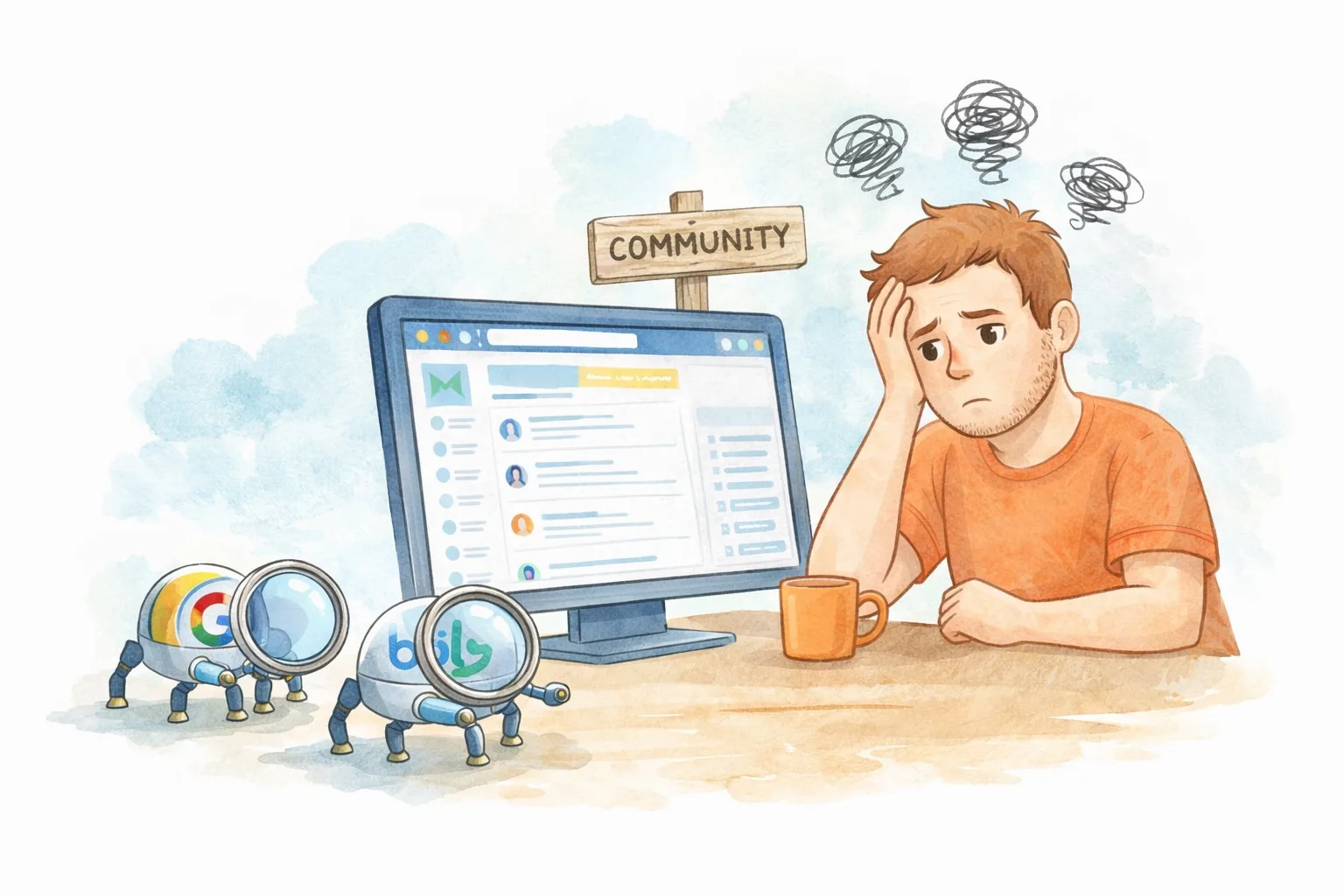
Your Community is Invisible to Search Engines
If search engines cannot crawl and index your community, you are building community in the hard mode. You will have rely on paid campaigns, brand recall, manual invites from existing members and social sharing to grow your membership.
...and it's really not an ideal growth model for a community.
A lot of communities are built on platforms that sit behind login walls or expose very little public content.
Public Content Drives Community Discovery
A public-facing community is a traffic magnet. Discussions, articles, event pages and all the user-generated content can bring organic traffic from search engines like Google, Bring and AI Chats Tools like ChatGPT, Perplexity and Google Gemini.
On the other hand, private-only community locks its content. All the valuable content remains hidden from the outside world.
Why Discord, Slack, WhatsApp and Telegram Are Weak for Organic Traffic
These tools are great at offering real-time chat environment. They allow members to exchange real-time information. However, they are bad for organic content discovery.
These tools do not give you indexable discussion pages, lack strong internal linking and clean information architecture.
In order to grow these communities, you will have to rely on member invites, paid promotions or landing pages to drive users.
It's expensive, fragile and not something you'd love doing for a long period of time.
Are You Publishing the Wong Kind of Content?
Communities have content. However, a very few communities have content that drives traffic.
Broadly, there are two types of content in most communities:
Topics of General Interest. Examples -
Where are you joining from?
I met a friend after 20 years; and you won't believe what happened next.
Topics that address pain-points
Dell P242SE Or Dell S3225QS - Which is better monitor for gaming?
What are the best tools for SEO under $59 for keyword research in D2C industry?
Topics of general interest will see a lot of participation only after the community is established, has a steady inflow of users and a large userbase.
The second type of content is what consistently drives traffic and engagement.
Understand the power of 'long-tail keywords'
Long-tail keywords are highly specific phrases that users are most likely to enter into search engine or AI chats. These are mostly the very specific pain-points that user wants answer to; often immediately.
Search engines and LLMs absolutely love the solved 'long-tail keyword' queries. Publishing long-tail content or modifying existing content on your community gives you quick win in search traffic.
Communities excel in this domain. Marketing pages can't address every query in QnA or Discussion format - but your community can.
SEO Content strategy for Communities
Large Communities: It's practically impossible to repurpose all the content. Head over to search engine console and find out the content that's attracting traffic. Typically, 20% of your content will pull 80% of the traffic. Focus only on it; and add 'noindex' to the 'thin' pages - like member profiles or unanswered discussions. You should be able to do this with a little bit of help from technical teams.
Small and Medium Communities: Build a community content calendar. Find out all the top pain points in the niche relevant to your community. Repurpose existing content and add new content strategically, focusing on the painkiller content with long-tail keywords.
Build Depth with a Topical Map
Topical Map is a concept usually discussed by the SEO Pros when building marketing content. It's a concept unheard of in the community world.
Topical map is how you convince the search engines that you are a dominant force in the niche that you operate in.
So, how do you build a topical map?
Okay, best and the most effective way to build a topical map for your community niche is to start with 'search intent'.
Search Intent is the Holy Grail
Community managers usually focus on the topics of their own interest. The goal is to focus on the content your existing and potential members are likely to search on Google or LLMs.
User intent - aka, what the user wants to achieve through search - is the key to building a topical map.
A topical map is like a tree of topics and subtopics interconnected with each other through links. The following image is the best representation of a topical map for the subject "Gardening".
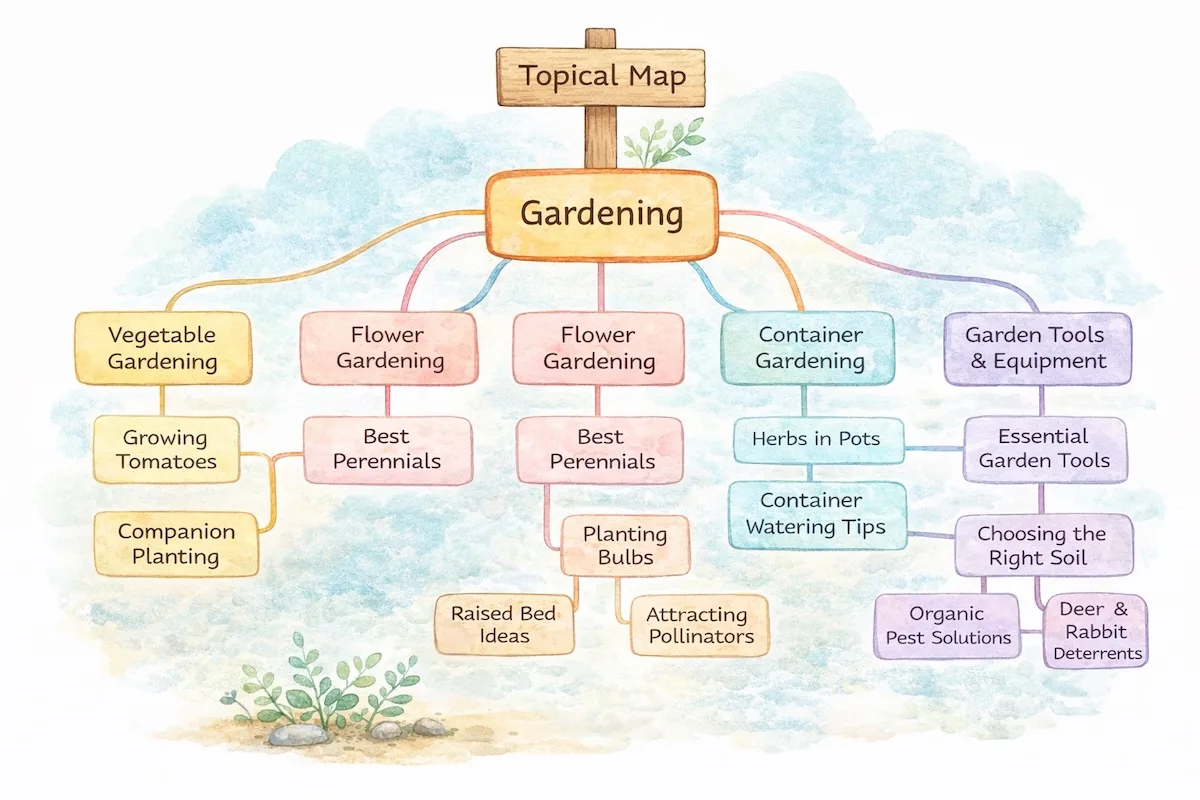
Look at the image above. The main topic is 'Gardening'. That sits at the center.
From there, it branches into subtopics like vegetable gardening, flower gardening, container gardening, gardening tools etc.
Each of these subtopics branches further into specific topics.
For example, the tools section has several topics underneath - essential tools, equipment, equipment under $30 and so on.
Vegetable gardening connects to topics like growing tomatoes and companion planting.
What this Means for Your Community
Now apply the same thinking to your community.
If your topic is 'emails marketing', start thinking about all the topics related to email marketing that your users care for.
email list building
email deliverability
email campaigns
email copywriting
email software, platforms etc.
Now consider each of these subtopics as 'root' and go deeper. It's recommended that you go 3-4 step deeper and find out the most common questions, pain points and queries in each sub-topics.
This should give you about 100 - 200 connected topics - and help you achieve 'real depth' with your content.
Note: Simply publishing more content is not the main goal here. Your focus should be on covering each topic in-depth.
Discussions Alone Rarely Build Full Funnel
Content in the form of Discussions is good start; but it's not enough. It can support search, but if you really want to go next level; you will need to add content in variety of formats.
It's recommended that you should focus on creating content across various formats: discussions, chats, articles, quizzes, polls, events, and more. It gives more opportunities for your members to engage with your community and stay longer. When people stay longer on websites; search engines trust your websites more.
Your Internal Linking is Weak or Inconsistent
One critical mistake most community managers make is ignoring the internal linking. Internal links solve two purpose:
Points users to different content or sections on your website
Allows search engines to pass on the ranking signals across different sections of the website
Establishing a sound internal linking profile is a quick win for most communities. Do not overdo this. Do not have more than 4-5 internal links on each page.
Your Community Content is Thin
Think content is everywhere in communities. When you rely solely on user-generated content, thin content is unavoidable.
However, there are auto-generated thin pages on your community that are manageable. "User Profiles" is one such target. If you can, please add 'noindex' to user-profile pages - informing search engines to ignore them.
Thin pages often hurt the site quality. Search engines typically have 'crawl budget' that gets exhausted while bots crawl thin pages. Either prune them from your site (returning 404 error) or simply add 'noindex' tag.
Characteristics of a High-Quality Community Page
Clear question, descriptive title
useful body text
specific and relevant examples
replies that add information and build a discussion
internal links to relevant content on the community
clean url example:
/discussion/how-to-grow-communitySolves a real problem that users care for
This is the standard. "Let's just add content and see if users like it" is how communities fill up with fluff.
Your Titles are Generic and Weak
Our member @paulad asked Is it okay to rewrite thread titles for better SEO? | Jatra Community
It's okay to rewrite the titles of the posts once the post is a few days old - provided change of the title does NOT affect the URL. Otherwise, you will end up setting a 301 redirect (in worst case, a 404 error).
It's common for people to write titles like:
Any thoughts?
Need Help?
Quick question about growth
These are terrible titles. No one searches for "any thoughts" on Google. As a community manager or a moderator - you must rewrite the bad titles and turn them into useful ones.
Tip 👍 : When rewriting title, think about the keywords users are likely to type into Google. Use them in your title.
Better titles will improve your Click-Through Rate (CTR) in searches and also improve the overall visibility of your content. If your titles are lazy, your traffic will be lazy as well.
You are Ignoring On-Page SEO Basics
This is where a platform focused on SEO helps. You can't alter the way your community platform handles content. However, an SEO / AEO focused community platform will offer the following features -
Semantic HTML
Proper title tags
Clean meta descriptions
Automatic Canonical URL generation
Open Graph Meta Data
Automatic XML Sitemap Generation
New SEO feature: Automatic follow and nofollow links in your content | Jatra Community
Advanced community platforms will allow for structured data snippets like "DiscussionForumPosting", "Article", "NewsArticle" automatically.
Hint 😍 : Jatra automatically adds structured data to your content.
How to Fix a Community That Gets No Traffic
There is no single fix.
If your community gets no traffic, it means the system is broken. You need to fix how content is created, structured, and discovered.
Start by changing one assumption.
Your community is not just a place for conversations. It is a content property. It needs search intent, structure, and consistency.
Then work through this in order.
Step 1. Make Your Content Discoverable
If search engines cannot access your content, nothing else matters. Keep most of your content public. Use private sections only where needed.
If your best content sits behind login, you have removed your biggest growth channel.
Step 2. Build Around Real Search Demand
Do not start with topics you want to discuss. Start with what people already search.
Pick one core topic. Build a cluster around it.
Create discussions, articles, and Q&A that answer specific questions. Link them together so they reinforce each other.
One strong cluster is better than fifty random posts.
Step 3. Fix Structure Before Scaling Content
Weak structure kills good content.
Rewrite vague titles. Clean up URLs. Improve descriptions. Merge or improve thin pages.
These are not cosmetic changes. They help search engines understand your content and improve rankings over time.
Step 4. Expand Beyond Discussions
Discussions alone limit your reach.
Add articles for depth, Q&A for specific problems, and updates or events where relevant.
Different formats capture different types of search intent. This increases your surface area.
Step 5. Seed With Intent, Not Volume
Early-stage communities need direction.
Create content based on real problems your users face. Use insights from sales calls, support tickets, and onboarding questions.
Do not wait for users to build your knowledge base. That comes later.
Step 6. Distribute to Create Initial Signals
SEO compounds, but it needs a starting push.
Share your best pages where your audience already spends time. This helps with discovery and gives you feedback on what topics work.
Distribution is not a substitute for SEO. It is what gets it moving.
Final Thoughts: Build a Public Knowledge Hub
Unless you have a solid reason to protect your content from the outside world, do not build a private community. Build a public knowledge hub instead - and host it on a platform that gives you compounding growth via SEO and AEO.
That's the way to keep your community growing organically.
Keep in mind - your community has the power no other channel can ever have. User generated content is a traffic goldmine - only if you let it do its job.
If you have questions - ask them below. I'll be happy to answer them for you.